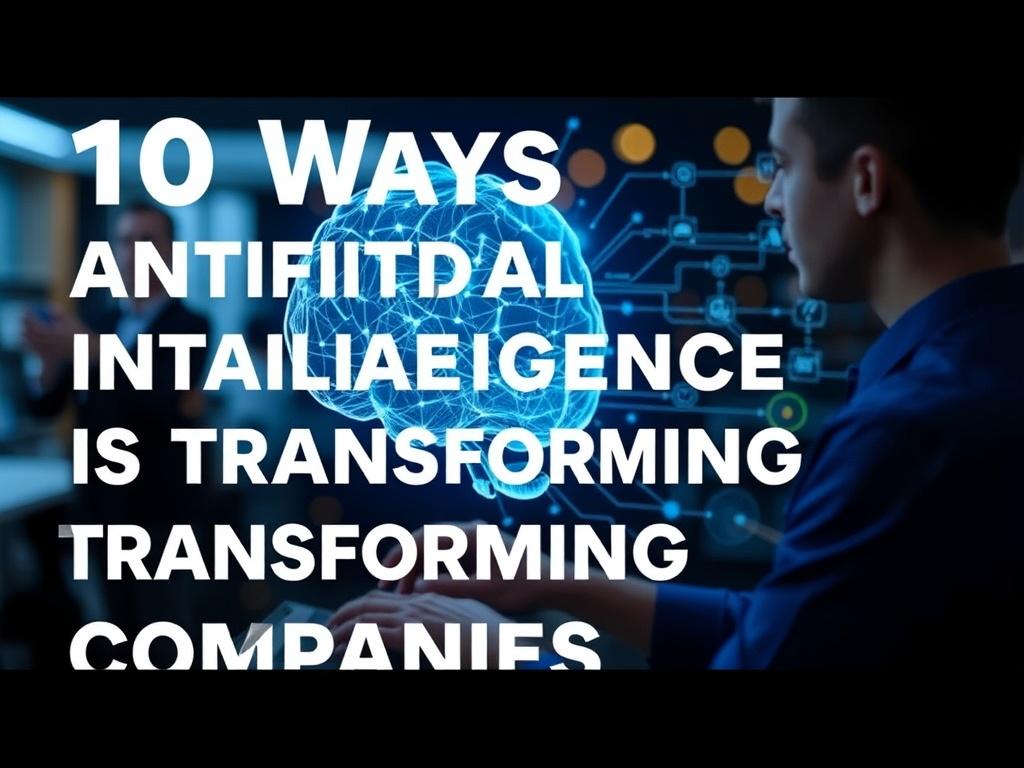
Walk through any modern company and you’ll see the fingerprints of artificial intelligence on the walls: smarter forecasts on whiteboards, cleaner support queues, fewer broken machines, tighter cash controls. This piece walks through 10 Ways Artificial Intelligence Is Transforming Companies, not as hype, but as day-by-day shifts in how decisions get made and work gets done. The throughline is simple: when models learn, organizations learn faster—provided leaders pair technology with process, talent, and guardrails.
A quick map of the terrain
Before diving deep, it helps to see the big picture. AI isn’t one thing; it’s a stack of capabilities—prediction, pattern recognition, generation, and control—that land differently in each function. The list below sketches the ten most common moves I see paying off across industries.
Think of these moves as modular. You don’t adopt all ten at once. Most firms start with one or two high‑value use cases, prove them out, and then expand as data quality, trust, and know‑how improve.
- Predictive analytics for planning and decisions
- Demand forecasting and smarter inventory
- Dynamic pricing and revenue management
- Personalized recommendations and offers
- AI‑powered customer support and triage
- Marketing segmentation and content at scale
- Process automation with human oversight
- Predictive maintenance and quality monitoring
- AI copilots that accelerate employee workflows
- Risk, fraud, and compliance analytics
Smarter decisions with data
Prediction turns ambiguity into odds, and odds beat gut feel. Teams use time‑series and causal models to run “what if” scenarios on promotions, ad spend, hiring plans, or capacity changes. The real win isn’t a perfect forecast; it’s clarity on ranges and tradeoffs so leaders can choose confidently and adjust early when signals shift.
I’ve sat with a merchandising team as they swapped a spreadsheet for a simple forecasting model and watched debate turn into focus. Instead of arguing over instinct, the team aligned around model ranges, set thresholds for action, and reviewed variance weekly. Better inputs, faster feedback, fewer surprises.
Customer experiences that feel personal
Recommender systems and uplift models tailor what customers see—products, articles, bundles, even prices—based on behavior and context. Done well, personalization feels like good service, not surveillance: timely, helpful, and relevant. The key is restraint and transparency, especially where consent and sensitive attributes are in play.
On the service side, AI handles the front door. Classifiers route issues to the right queue; assistants draft responses; summarizers hand agents crisp context. I still remember the first time a support manager told me hold times dropped without hiring more people—because triage got smarter and knowledge surfaced itself.
Operations that learn and adapt
Beyond chat and dashboards, AI is quietly tuning the engine room. In manufacturing, vision systems catch defects earlier; in logistics, routing models shave miles and minutes; in energy and facilities, control systems squeeze waste out of heating and cooling. These aren’t moonshots. They’re cumulative gains that add up on the P&L.
In many plants and warehouses, the shift looks like this:
| Area | Old way | AI‑enabled shift |
|---|---|---|
| Scheduling | Fixed shifts, manual swaps | Demand‑aware rosters that update daily |
| Quality control | Sample checks each hour | Real‑time vision inspection on every unit |
| Maintenance | Calendar‑based service | Condition‑based alerts and targeted repairs |
| Routing | Static routes and heuristics | Adaptive paths based on live traffic and constraints |
New ways of working for teams
AI copilots change the shape of a workday. Developers get code suggestions and test scaffolds; analysts generate first‑pass queries and charts; product managers draft PRDs and user stories from call notes. The point isn’t to replace expertise, but to move people from blank page to critical edit faster—and to free time for the knotty parts machines still fumble.
Knowledge retrieval is another quiet upgrade. Vector search pulls relevant pages, tickets, and transcripts across messy repositories, so employees spend less time spelunking through outdated wikis. With good governance—access controls, red‑team reviews, and feedback loops—these assistants become reliable teammates rather than novelty tools.
Pricing, revenue, and the market dance
Dynamic pricing blends demand signals, competitor moves, and inventory positions to set prices that flex without whiplash. The art is in constraints: guardrails to avoid price cliffs, fairness rules for regulated markets, and human review for sensitive products. Revenue managers pair these models with A/B tests to learn quickly without alienating loyal customers.
Marketing gets its own lift. Clustering and look‑alike models sharpen audience selection, while generative systems produce variant copy and imagery for creative testing. The best teams keep a human in the loop, enforce brand standards, and measure outcomes rather than outputs.
Stronger risk, finance, and compliance
Fraudsters move fast; models move faster. Transaction scoring, device fingerprinting, and anomaly detection cut losses while reducing false declines that frustrate good customers. In lending and underwriting, interpretable models and bias audits help teams balance accuracy with fairness—backed by clear documentation for regulators.
Legal and finance benefit, too. Contract analysis flags clauses that deviate from playbooks; invoice matching spots duplicates and errors; forecasting tools tie together sales pipelines, seasonality, and macro indicators. The throughline is control: robust monitoring, drift detection, and incident playbooks so leaders trust what the models are doing when no one is looking.
Putting it all together
You don’t need a moonshot to start. Pick a painful decision or repetitive workflow, define success in business terms, and ship a scrappy version within a quarter. Pair data scientists with operators, set up a feedback loop, and plan for handoffs so the win sticks after the demo glow fades.
Companies that treat AI as a capability—not a project—build momentum. They set standards for data quality, model governance, and change management; they invest in training so employees feel empowered, not sidelined. Do that, and the 10 Ways Artificial Intelligence Is Transforming Companies stop being a list and start becoming muscle memory across the business.